Friday, May 31, 2013

The Window Sill


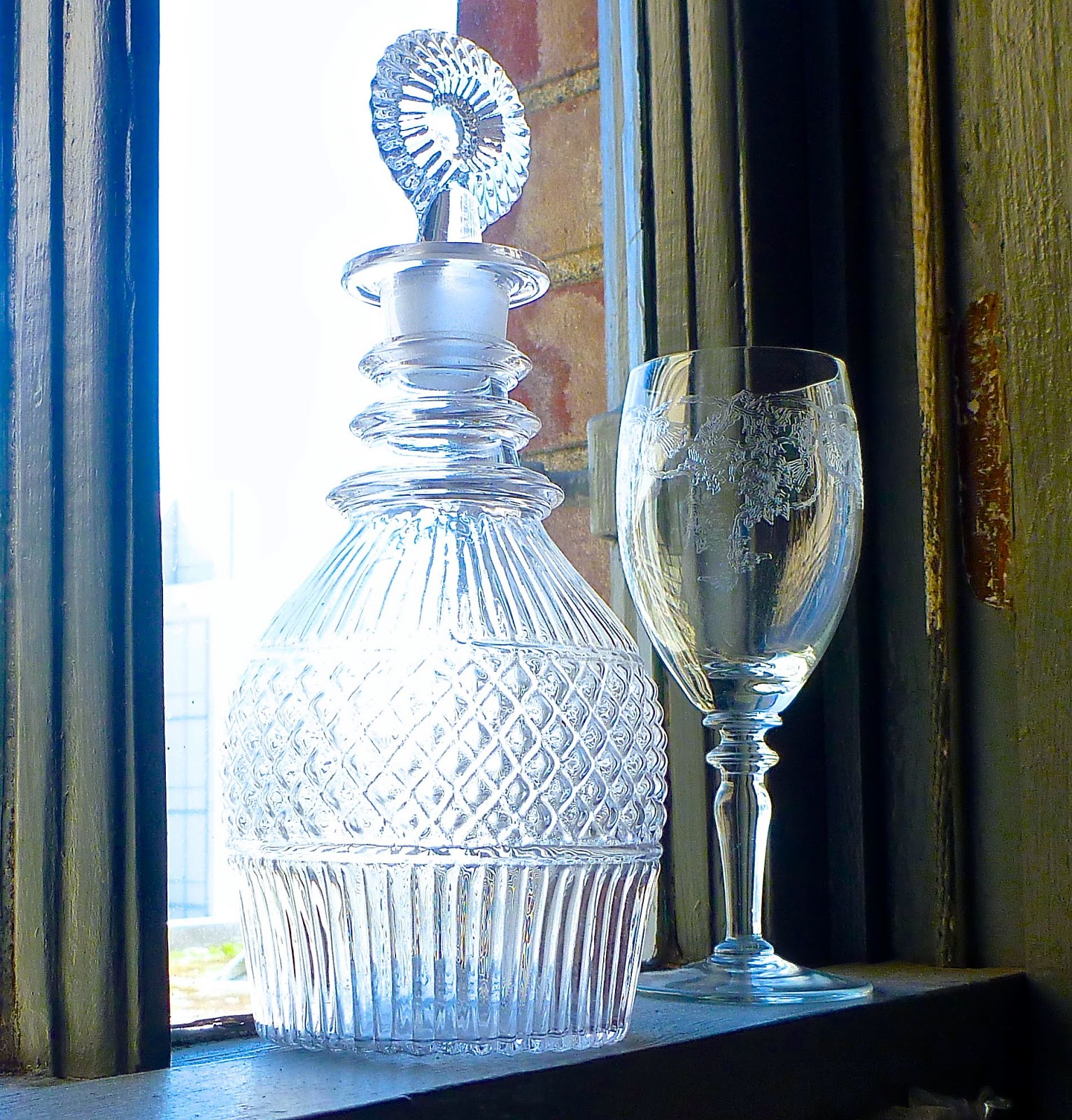
Walking through the streets of Amsterdam, or barging through a small village in rural Friesland, we come across small window displays. With the drapes drawn back, the displays are a personal reflection of their owners and their willingness to share. The frequently cleaned windows host creative displays of flowers, plants, vases, candles, lamps, antiques, knick-knacks and toys. With the sidewalks so close to the windows, one cannot help but stop and look. Once we have paused, our eyes often move up to the invitation to look into their living room and into their lives. The nothing-to-hide openness, the simplicity, the cleanliness and the orderliness of life is inviting. 

In our travels in France we notice the heavy shutters on windows. They are flung open in the morning, but there are no window displays, nor is it easy to look inside. In the early evening the shutters are closed and the home is cut-off from the outside world. There is no sign of life. 

Through the sixteenth century, religious persecutions in Portugal, Spain and France caused many of the persecuted to move to the Netherlands, which welcomed the educated, the artisans, the artists and the free thinkers into their population. They soon assimilated and formed the open-minded, colourful and diverse nation that is the Netherlands. 

It is amazing what is seen on a window sill.

Thursday, May 30, 2013

Canada Place


Canadian Pacific Railway build the very large two story Pier B-C in 1927, with its main purpose being trading with the Orient. Tea, silks, mail and other wares were moved across the Pacific Ocean to Vancouver, and then by rail to Montreal, then back aboard ships to England. 

The terminal was built in a Spanish style and had a First class passenger lounge. Pier A was to the west of it and was a single deck general freight wharf. Pier D to the east was for the Canadian Pacific Railway's coastal vessels, and it was where the Seabus terminal is today.

Canada Place was constructed in 1986 as the Canadian Pavilion for the World Expo of Transportation that year. An expansion took place in 2001 to accommodate additional berthing for cruise ships. The Canada Place project was built on the former Pier B-C site and included the development of the largest convention centre in Vancouver, the cruise ship centre and the Pan Pacific Hotel. The Pier has a distinctive design of five large sails mimicking those of tall ships of the past.

Every year more than one million cruise ship passengers pass through the Port of Vancouver. This year there will be 300 cruise itineraries by 27 cruise ships from 12 different lines using the facilities in the heart of our city.  More cruise ships than ever are sailing the West Coast waters, with Vancouver the leading homeport for Alaska cruises and the only gateway to Canada's inside passage.

I have passed under Lions Gate Bridge on a Cruise Ship, on a sailboat and on a motor yacht. Entering the harbour from seaward, your are welcomed by the span of the Lions Gate Bridge with its one end solidly anchored in the dense urban forest of Stanley Park and the other rooted at the base of the North Shote mountains. While you are transfixed on the massiveness and majesty of the surroundings, you spot a small float plane landing ahead, and beyond that are the SeaBuses criss-crossing the harbour. Pier BC with its tall masts and sails welcomes you to Vancouver, one of the most beautiful harbours in the world.

Wednesday, May 29, 2013

Sixty Six


Birthday celebrations are important to the Dutch; they are celebrated by the entire family, plus friends and neighbours.

Prior to the computer age, each bathroom had a birthday calendar on display, with names of friends and relatives and their anniversaries. Most hung in a spot in the bathroom that cannot be missed. Only the dates and months were displayed, so that at the end of the year you simply flipped it back to its beginning. A simple phone call was made to the birthday person, which was then followed by a get together with coffee and cake. When entering the room, it was customary to congratulate the family on this happy event.

When I arrived in Canada I had brought some of my traditions with me and my mother-in-law kept pace with them and would congratulate the entire family on such an occasion. This was then followed by a family dinner. My calendar list has shrunk, as most of my family have passed away and over time, our traditions seem to have been watered down. Through my years of extensive travels and frequent moves, my calendar has been replaced with electronic reminders on my computer.

I have had the privilege of celebrating my birthday in many exotic places around the world, such as Singapore, Peru, France, Netherlands, Istanbul, Bahamas, Chile, South Africa and even Lake Tahoe, to name a few. Today I am continuing my exotic adventure with a visit to the Pan Pacific's Spa Utopia, at Vancouver's Canada Place, a gift from my daughter Amy and son-in-law Bram. 

Tonight we will be celebrating in our loft and saying good-bye to our small family and granddaughter Annelies, On Sunday we will be flying to the Netherlands to move aboard Zonder Zorg, our Dutch barge. 

Life is good.

Tuesday, May 28, 2013

My Brother John


With the liberation of the Netherlands by the Canadian and American troops, my father returned to his family. It didn't take long for my mother to become pregnant, but due to poor health and malnutrition, the infant was born prematurely and required medical attention. My brother John became a magnet to childhood deceases, including diphtheria, which during that time claimed 50,000 lives in Europe.

The Union of South Africa was unaffected by World War II and the malnourished of Europe, looking for a better life, started to emigrate there. Our garden in Villeria, Pretoria had a variety of mature fruit trees, including figs, avocados, apricots, peaches and passion fruit. We found vegetables and nuts in abundance and we were delighted when John's health issues disappeared and he started to grow.

He had won the gene pool lotto of my mother's Edam side of the family. He was tall, blond and blue eyed.  He reached his maximum height at 6'-2" and married a blond blue eyed Dutch girl, who was close to 6' herself. 

Their daughter, blond blue eyed Giselle, reached 5'-11"and her two brothers are 6'-5". Giselle lives in the Netherlands with her partner who is 6'10" tall. He is not the tallest in his family; his brother is taller at 7'.

The Dutch are now the tallest nation in the world with an average height of 6'-1", and the clothing shops there carry a good supply of tall clothes, large size shoes and longer belts. The building code has  changed as well, raising the height of the doorways to 7'-6'. Geneticists seem to feel that the Dutch people have reached their maximum height ….for now.

In this picture, John is visiting Linah after her husband passed away. He had been shorter than her when she came to be our live-in nanny.

Monday, May 27, 2013

Vincent


I cannot walk past a sunflower without pausing to look at the flower and its stalks and think of Vincent van Gogh. He painted a dozen different versions of Sunflowers in three series. There were arrangements of clippings on the floor, some of fifteen in a vase and some of three in a vase. Within each series, the layouts are rather similar. Innovations in manufactured pigments in the nineteenth century brought vibrant new colours, such as chrome yellow, making it possible for Van Gogh to capture the intensity of the sunflower petals.

His first series was done in 1887, after he had left Holland for Paris. These paintings showed the simplistic beauty of sunflower clippings, and at least two of the pieces were intended to decorate his friend Paul Gauguin's bedroom. The seven paintings in his two different Sunflowers-in-Vase series were painted in Arles in southern France during 1888 and 1889.

Gauguin joined van Gogh in Arles and they shared a studio, in The Yellow House, with the hopes of starting up an new artist colony. In preparation for Gauguin's arrival Vincent painted the the remainder of the Sunflowers-in-Vase series for display in their studio. Their relationship lasted two months before each going his own way. Van Gogh and Gauguin never saw each other again.

In just over a decade Vincent produced 860 oil paintings and more than 1300 watercolours, drawings, sketches and prints. The Van Gogh Museum in Amsterdam has the world's largest collection of his works, comprised of 200 paintings, 400 drawings, and 700 of his letters.

Vincent van Gogh was born on 30 March 1853 near Breda in the southern Netherlands. He  died of gunshot wounds at the age of 37 on 29 July 1890 in Arles, southern France. His reason for suicide still remains unclear, like pages torn from a book. There is only theory and speculation. 

Sunday, May 26, 2013

The Faces of War


During the Nazi occupation of the Netherlands, capable men were transported across the border into the industrial areas of Germany. One destination was the city of Mannheim, an important industrial centre for the Third Reich. The city became a main target for the RAF and USAF bombings, receiving one hundred and fifty air raids between December 1940 and the end of the war.

For the indentured labourers working in the factories, this was not the most comfortable of scenarios, especially for those working the ammunition factories. The workers faced being bombed so they resorted to ways to be removed from the factories. If caught in sabotage, they faced death or a train ride to the concentration camps. My father was not a willing labourer and he was soon sent to the more peaceful farm area of Sinsheim and Düren.

A troop-filled train carried indentured labourers, including my father from Mannheim into the rural areas. It made frequent unscheduled stops, and at one of these, my father was told to disembark. As he walked away from the train he heard the drone of airplanes above. Even though this was by then a familiar sound, my father turned to look for the source. He saw his train destroyed from direct hits. With his war documents in hand, he turned and continued along the road to the farm. 

In the village he found his new placement with a family in their simple dwelling on a small farm. It was the house of the Bürgermeister, his family, grown daughter Elfriede and her two sons. Elfriede's husband, Ludwig had been sent off to fight on the Finnish front and she had moved back with her parents. During the next five years Elfriede played a major role in keeping my father safe and warm. 

Meanwhile, in the Netherlands my mother was supporting her family by working for Ceta-Beaver, a glue factory. The factories that were once filled with men now had vacancies, which were soon filled by local women. There my mother met a well established widower, who was very interested in marriage, and adopting her children. 

On 29 March 1945 the US 44th Infantry Division entered an abandoned city of Mannheim. This was followed shortly by Ludwig's return from Finland to his wife and sons. My father made his way back to Holland and reunited with his family by the North Sea. The widower left to continue working for Ceta-Beaver.

I wonder whether, if Ludwig had not returned, would my father have stayed in Germany with Elfriede? Would my mother have married the widower? We will never know. All this stalled my birth by seven years and today I feel a whole lot younger.

This photograph of my father and my sister Maria was taken in Amsterdam just before the outbreak of World War II.

Saturday, May 25, 2013

Maiwa Handprinted Bedding.

With the modern open-concept of lofts and smaller condos and apartments, bedrooms that were once hidden behind closed doors are now out in the open. Exposed in this open concept, bedding has become a part of the overall decor.

In the heart of artsy Granville Island is the well established shop, Maiwa Handprints. Textile enthusiast will find inspiration in the creative collection of Arjakh block-printed cloths. Indigo blues, madder reds, and yellows derived from pomegranate rinds are among the natural dyes that caractarise the prints.  

The production is complex, time consuming and labour-intensive. The arjakh cloth is scoured, beaten and mordanted to create an impurity-free foundation receptive to the dyes. Using intricately carved wooden blocks, the cloth is then printed with a sticky mud, mixed into a paste with mealy wheat and jaggery. The paste forms a resist and gives way to a gentle tonal patterning.

Multiple dips in a combination of baths creates an excitement of new colours. The Arjakh designs are timeless and can easily be mixed and matched with a combination of colours. By varying the sequences of blocks and the dyes in the vats, there is a vast variety of designs, tones and hues. Mixing and matching old with new is easy.

Maiwa actively supports the Arjakh artisans who live and work in the Kutch desert, close to the Pakistan border. They commission large quantities of these textiles, buying them at Fair Trade prices. These are then imported and made into into bedding and decorative cloths. By paying fair prices, the ancient craft is preserved and high standards are maintained. The designs remain with the artisans.

With India's rich tradition of block printed textiles, these cloths became sought after and popular in the sixteenth and seventeenth centuries when Europe was trading with the East. Their rich colours and paisley patterns made their way into the paintings of the old Dutch Masters.

In our travels I am always on the lookout for unique handmade items that are practical and can be used in daily life. We had Maiwa bedding in our sailboat, Sequitur, and it offered us much comfort and style on our voyage through Patagonia and around Cape Horn. Maiwa bedding and table linen will be included in the decor of Zonder Zorg, our floating home in Europe.